
AI at Work for Managers: A 2-Part Guide
Part 1 of 2
Managers spend a lot of time in meetings, emails, status updates, and follow-ups. AI can help a great deal with that job. In fact, 85% of firms today are using AI in at least one business activity, according to McKinsey.
That doesn’t mean the AI replaces managers. This allows them to spend less time on regular work and more time on planning, coaching, and decision-making.
In this article, we’ll explore how managers can practically use AI at work, the prompts managers can use today, and some safety considerations to keep in mind.
Why Are Managers Using AI at Work
Managers spend most of the day keeping things on track. Meetings generate follow-ups, projects require progress updates, and teams depend on quick decisions. AI helps take a piece of that load off, freeing up managers to spend more time on strategy, coaching and leading their people.
Here’s why more managers are embracing AI on the job:
1. Reduce administrative work
Managers spend hours each week taking notes, sending emails, and preparing updates. AI is doing a lot of busy work and gives you more time to do the things that need attention.
2. Sharpen follow-through
Action items can easily get lost in the shuffle after a meeting. AI helps in capturing crucial lessons, assigning next steps and keeping projects moving forward.
3. Please keep the information in order
Important information is often scattered between emails, documents, chats, and meetings. AI helps to tie it all together so managers can find what they need without wasting time.
4. Speed up daily tasks
AI lets managers execute basic jobs without starting from scratch – from preparing meeting agendas to composing status updates.
5. Develop More Reliable Processes
Structure notes, reports and documentation, and improve the work of teams. AI helps get that consistency across projects and divisions.
AI isn’t designed to eliminate expertise or judgment. They use it to spend less time on monotonous tasks and have more time to support their teams and make better decisions.
How to Use Generative AI at Work Effectively
A lot of the value you receive from AI is in how you use it, not which tool you use. Managers who receive good results from AI do not see it as a silver bullet. They use it to support how they already work.
Here are some methods to do more using AI at work:
1. Begin with repeated tasks
AI is at its best when it takes care of the job you do over and over. Meeting notes, status updates, agendas and rough first drafts are all useful starting points.
2. Give it an adequate background
The AI can only work with the data you provide it. Tell it what you want to accomplish, who you’re doing it for, and anything else you want it to remember. Usually, a little more context may go a long way.
3. Have a look through the output
AI can make mistakes. Sometimes the mistakes are clear. Sometimes they are not. Verify the facts, data, and details before discussing anything with clients, leaders, or teammates.
4. AI to support decisions, not to make decisions
AI can help you think through ideas and organize information, but it doesn’t know your team’s history, or the trade-offs behind every choice. That aspect is still up to you.
5. Create prompts for regular activities
Much of the work is copied. If you’re writing the same project updates, running one-on-ones, or prepping meeting agendas every week, save the prompts that work. It saves time and helps to keep everything uniform.
6. Think of the entire procedure
The largest benefits tend to be about enhancing an entire workflow, not just a single activity. For example, AI meeting assistant is capable of more than just taking notes. It can pull out action items, summarize choices, and speed up follow-ups.
Also Read: Aimey vs Fireflies: Comparing Meeting Notes, Agendas, and Automation
14 Ways to Use AI at Work
AI is best used to take repetitive work off a manager’s plate. It’s not about automated leadership. It means less time doing admin work and more time doing execution, coaching and decision-making.
Here are 14 ways managers can put AI to work in a pragmatic way.
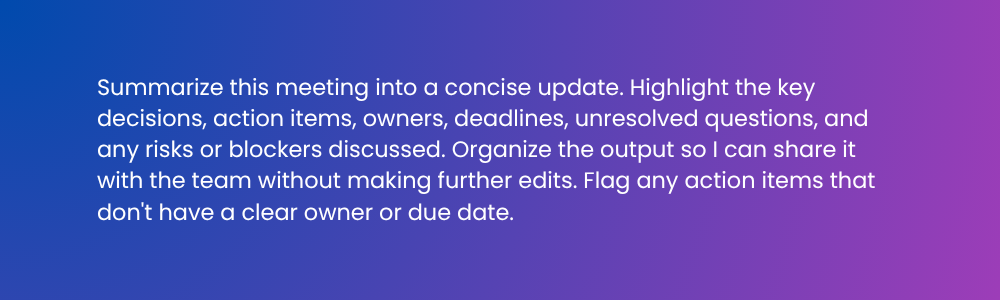
1. Summarizing Meetings and Documenting Action Items
Managers may have spent the majority of their week in meetings, but the real work begins when the meeting ends. Teams need clarity on decisions, ownership, and what to do next. Without a reliable process, action items can get lost in notes or simply forgotten.
AI can pore over meeting transcripts, identify key decisions, uncover open questions, and consolidate follow-ups into an organized summary. This creates a common understanding and decreases the time spent on reconstructing conversations.
For example, a department head can summarize a weekly leadership meeting and distribute decisions, owners, and deadlines to stakeholders in minutes.
Here’s how the prompt would look:
2. Prepare Stakeholder Updates
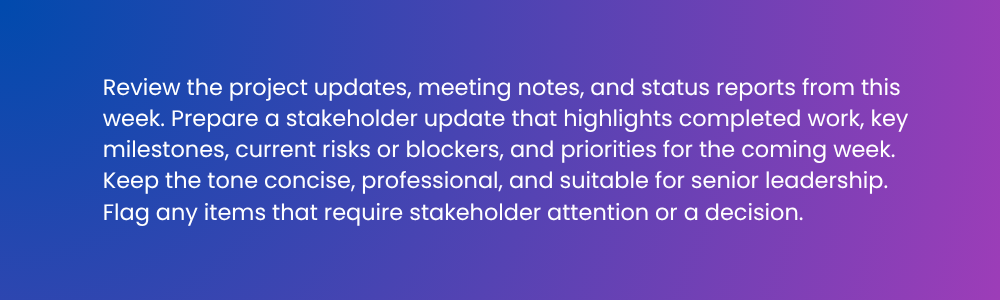
Stakeholders need to see progress, risks, and priorities. It often takes longer than managers think to get those updates prepared.
AI can turn project notes, meetings and status reports into quick updates for executives, customers, or internal teams. This helps managers communicate uniformly without spending hours writing reports.
A Project Manager can transform weekly notes into an Executive Update that captures accomplishments, risks, and upcoming milestones.
Here’s how the prompt would look:
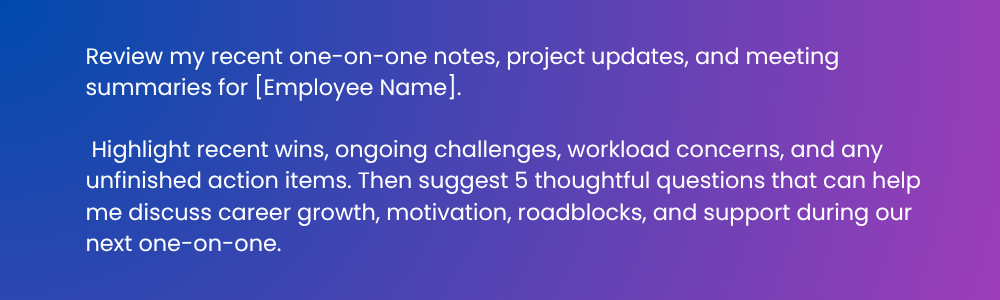
3. Be Ready for One-On-One Meetings
Managers who don’t have time to prepare often turn one on ones into status reviews. Important discussions on development, motivation, and support are assigned to the back seat.
AI can help managers find discussion topics, summarize recent successes, and offer questions that lead to meaningful conversations.
Prior to a monthly check-in, a manager can review recent project activity to prepare talking points about workload, growth, and challenges.
Here’s how the prompt would look:
4. Develop Project Plans
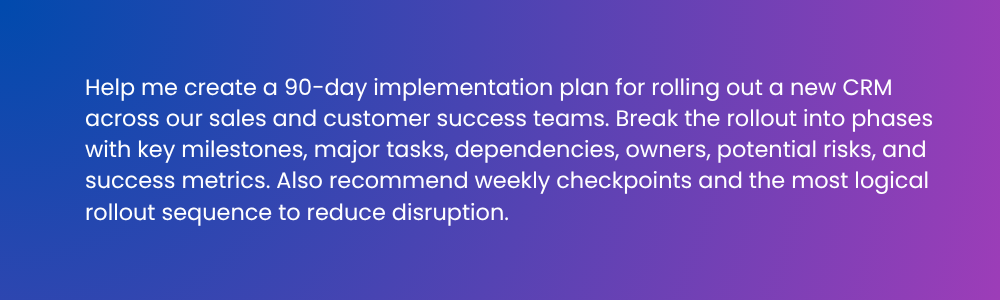
Big initiatives often begin with ideas floating around in emails, meetings, and whiteboards. Execution is dependent on structure.
AI can help to structure initiatives into milestones, dependencies, timelines, and success criteria. This gives managers a solid base to play around with the team.
Example: An operations leader can develop a 90-day rollout plan for a new CRM or customer onboarding process.
Here’s how the prompt would look:
5. Read reports and documents
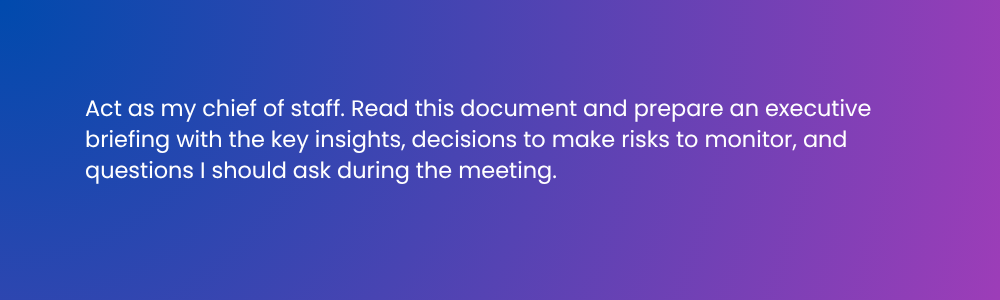
Managers have little time to read every report in its entirety. They need the findings. They need the risks. They need the decisions that require attention.
AI can pull out the important information from long documents and present it in a way that is easier to digest and discuss.
So a director might take a 40-page report and turn it into an executive briefing on the key findings and recommendations.
Here’s how the prompt would look:
6. Prepare Presentation Outlines
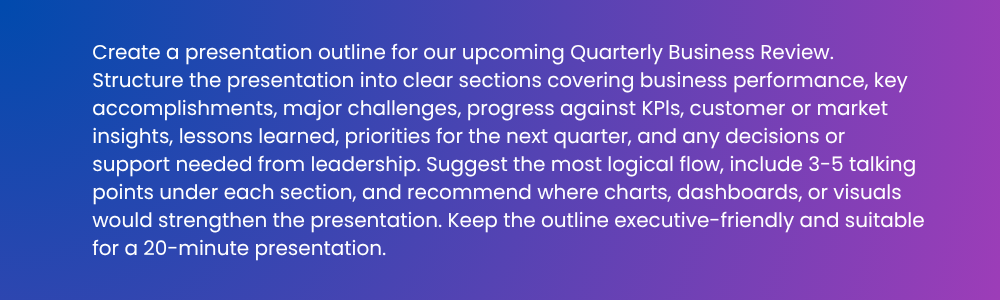
Often, the process of building presentations begins with a blank slide deck. Usually, it takes more time to organize the ideas than to actually make the slides itself.
AI can help to structure the narratives, group related topics, and suggest a logical flow to presentations.
For example: A team leader can prepare a quarterly business review that includes accomplishments, challenges, metrics, and priorities.
Here’s how the prompt would look:
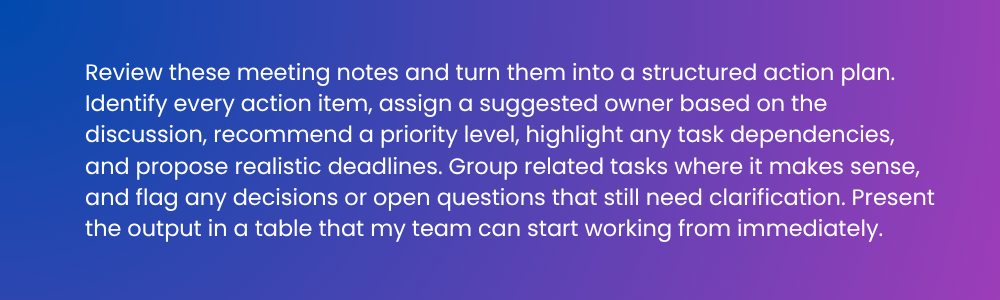
7. Convert Notes to Tasks
Brainstorming sessions, workshops, and strategy meetings often create pages and pages of notes, but very little accountability. Ideas sound good in the room, but lose steam when no one owns the work.
That gap can be helped by AI converting unstructured notes into organized tasks with priorities, dependencies and suggested owners. This enables managers to transition teams from discussion to execution without hours spent on cleaning up meeting notes.
After a planning session, a manager can take a page of notes and turn it into a structured action plan with deadlines and responsibilities.
Here’s how the prompt would look:
8. Look at Customer Feedback
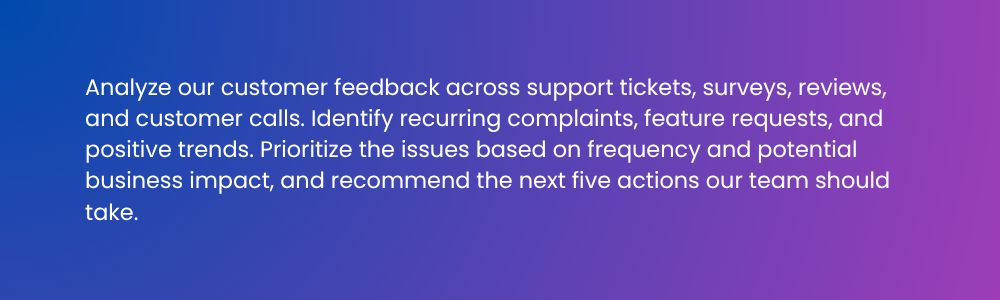
Customer insights are rarely gained from one source. Feedback comes in through surveys, support tickets, reviews, account calls, and sales conversations. That volume can be difficult to make sense of.
AI can surface recurring themes, identify common pain points and surface feature requests that need to be addressed. Rather than anecdotally, managers are able to decide based on patterns across hundreds or thousands of customer interactions.
For example, a customer success leader might look at support chats to see which problems are causing the most complaints and then prioritize fixing those.
Here’s how the prompt would look:
9. Think of Ideas and Solutions
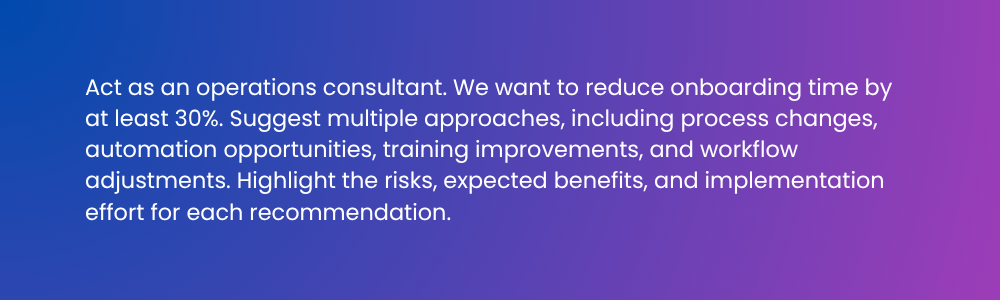
Sometimes the team gets stuck on the same response. When you look at the problem from a few different angles, you open up options that weren’t on the table in the initial discussion.
AI can help generate alternatives, surface trade-offs, and provide a jumping-off point for deeper conversations. The value is not finding the answer. The value is in getting the conversation out.
A manager can experiment with various approaches to cut down on onboarding time before making suggestions to the team.
Here’s how the prompt would look:
10. Conduct Performance Reviews
Performance reviews require managers to look back on months of work, projects, and discussions. History is often constructed from memory, and this can lead to incomplete or contradictory feedback.
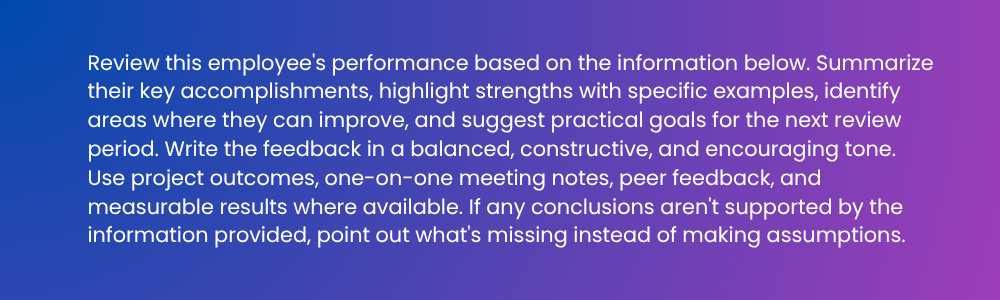
AI can help translate accomplishments, strengths, opportunities for development and goals into a coherent narrative. Managers can then refine the output so that the feedback reflects their own observations and coaching conversations.
Project results, peer feedback, and one-on-one notes can help a team manager write balanced performance reviews for the team.
Here’s how the prompt would look:
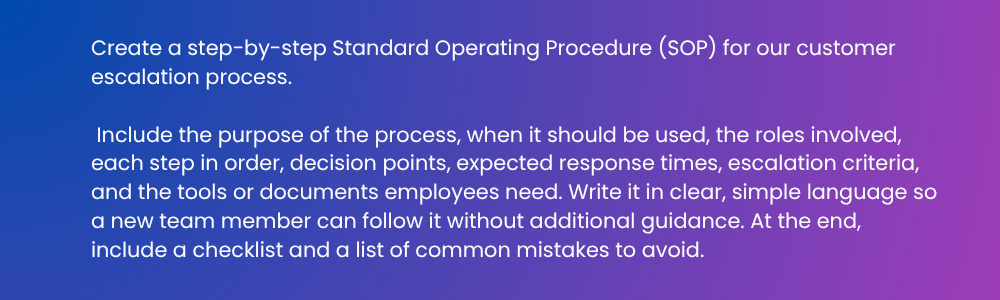
11. Write Standard Operating Procedures
As organizations grow, consistency becomes harder to maintain. Unnecessary risk is created, and onboarding becomes harder with processes that live inside people’s heads.
AI helps document workflows, define responsibilities and create standard operating procedures teams can use. This will minimize confusion and make it easier to pass knowledge on to other departments.
For instance, an operations manager could document processes for customer escalations, employee onboarding, or incident management.
Here’s how the prompt would look:
12. Create Meeting Agendas
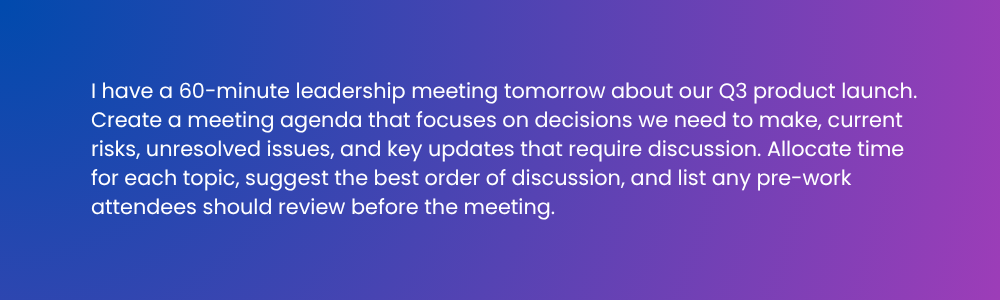
A meeting agenda is more than a list of topics. It helps people come to the table prepared and keeps the discussion focused on decisions needing attention.
AI can help managers to organize meetings around priorities rather than pulling together agendas at the last minute.
Example: Instead of status updates, a manager can build an agenda around risks, decisions, and open issues before a leadership meeting.
Here’s how the prompt would look:
Must Read: 5 Meeting Minutes Examples & Template (And How to Automate Them)
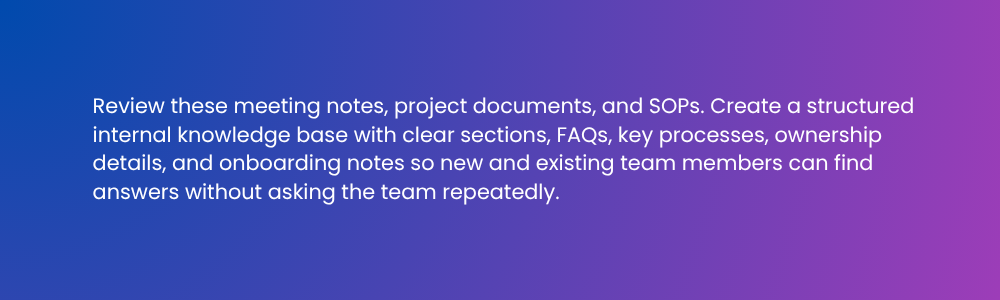
13. Knowledge and Documentation Framework
As organizations grow, information fragments. Teams generate valuable insights in documents, chats, emails, and meeting notes, but it’s hard for people to find what they need.
AI can help organize that information into structured documentation, internal knowledge bases and FAQs. That makes it easier to find information and reduces the need to keep answering the same questions.
Department heads can take project documents and meeting summaries and turn them into onboarding materials for new employees.
Here’s how the prompt would look:
14. Identify Risks and Roadblocks
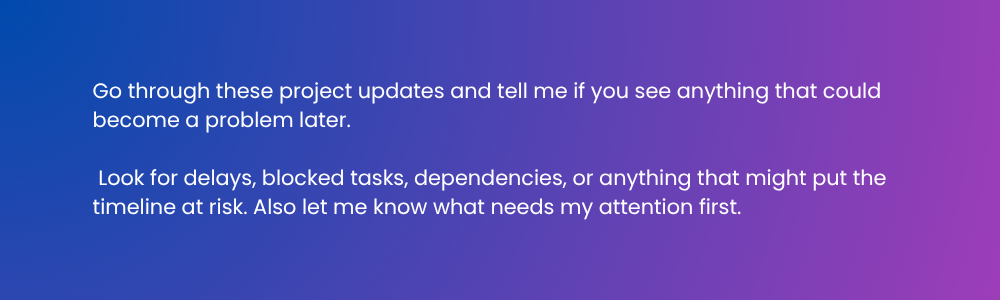
Problems don’t just suddenly pop up. Small delays and unresolved dependencies are often staring at you in the face until they begin to affect deadlines and budgets.
AI can help managers identify those warning signs earlier, dependencies, recurring issues and things that need to be looked at more closely.
For example, a program manager can review weekly updates on the project and spot possible delivery problems before they become big problems.
Here’s how the prompt would look:
You’ve covered the fundamentals. Now let’s take the next step.
What’s Next: Using AI at Work Safely
Knowing how to use AI is only part of the equation. Managers also need to understand how to use AI safely, where AI meeting assistants and transcription tools fit into everyday workflows, and how to choose the right tools for their teams.
In Part 2, we’ll explore practical AI safety tips for managers, how AI meeting assistants and transcription can support day-to-day work, and how Aimey.ai can help managers put AI to work more effectively.
👉 Continue reading: AI Safety Best Practices for Managers in the Workplace