
Every operational decision leaves a trail. A process update, a vendor discussion, a change in timelines, it usually starts in a meeting and then moves straight into execution.
The problem is not the conversation, but what comes after. Notes are often incomplete, context fades, and ownership does not always carry through the way it should.
Teams revisit decisions they thought were settled. Handoffs slow down because details are unclear. Follow-ups depend on scattered notes across inboxes and calendars. What should be one clear record ends up spread across different places.
That is why the choice of an AI meeting assistant for operations teams matters. It helps turn discussions into clear actions and keeps work moving without extra coordination. Here is how to evaluate one without missing what matters.
Why Operations Teams Struggle to Track Meeting Decisions
Operations teams spend their day moving from one thing to the next. Meetings are where timelines get set, issues get sorted, and next steps are agreed. But once the call ends, not everything is as clear as it felt in the moment.
This is where things usually start to slip:
- No time: One meeting rolls into the next. People think they will update notes later, but by then the details are already a bit fuzzy.
- Missing context: Most notes capture what was decided. They rarely capture why. That context is what people look for later when something needs to be revisited.
- Scattered decisions: A decision might be discussed in a team sync, then again in a review call. Without one place to track it, people end up joining the dots themselves.
- Unclear ownership: In the moment, it feels obvious who will do what. Later, it is not always written down, and things slow down because of that gap.
- Memory gaps: The team goes back through chats or notes to piece together what was discussed a few days ago. It works, but it takes time and is not always exact.
For most operations teams, the problem is not the meeting itself. It is what gets lost once the meeting is over.
What to Look for in an AI Meeting Assistant for Operations Teams
Operations teams usually don’t struggle with capturing meetings. The real challenge starts when they try to actually use those notes for decisions, audits, or follow-ups.
So the question isn’t “did we record the meeting?” It’s “can we rely on this later?”
Here’s what tends to matter in practice:
- Compliance and data security: Operations conversations are sensitive, so teams care about who can access what, where the data sits, and whether it meets internal and regulatory standards.
- Notes that actually make sense later: A transcript is rarely useful on its own. What teams need is a clear view of what changed, what was approved, and what needs attention next.
- Something that works during audits too: When someone asks “why was this decided?”, the answer shouldn’t require digging through multiple meetings or Slack threads.
- A connected view across meetings: Most decisions don’t happen in one discussion. Teams want to see the thread, not isolated snapshots.
- Follow-ups that don’t get lost: If ownership isn’t clear, tasks slip. And then the meeting becomes just another conversation instead of progress.
How Operations Teams Use AI Meeting Assistants
Operations teams keep things moving across people, timelines, and priorities. The challenge is not just capturing discussions, but being able to revisit them and act with clarity.
Here’s where an AI meeting assistant helps:
- Planning reviews and operational changes: Plans change often, with timelines changing and priorities getting updated. A clear record helps teams understand what changed, who agreed, and what needs to happen next.
- Leadership updates and reporting: Preparing updates for leadership usually involves pulling inputs from multiple meetings. When notes are scattered, this slows the process. Structured records make it easier to extract key decisions and present them clearly.
- Vendor coordination and delivery tracking: Vendors commit to timelines and deliverables across different calls. Missing details can lead to delays or confusion later. A clear summary helps teams stay aligned with what was agreed.
- Cross-functional alignment: Operations teams work across departments, each with its own context. Information can get lost as it moves between teams. A shared record keeps everyone aligned and reduces repeated discussions.
- Internal reviews and accountability checks: Teams often need to revisit decisions and track what followed. This becomes difficult with scattered notes. Consistent documentation makes reviews simpler and more reliable.
Common Problems with AI Meeting Tools in Operations
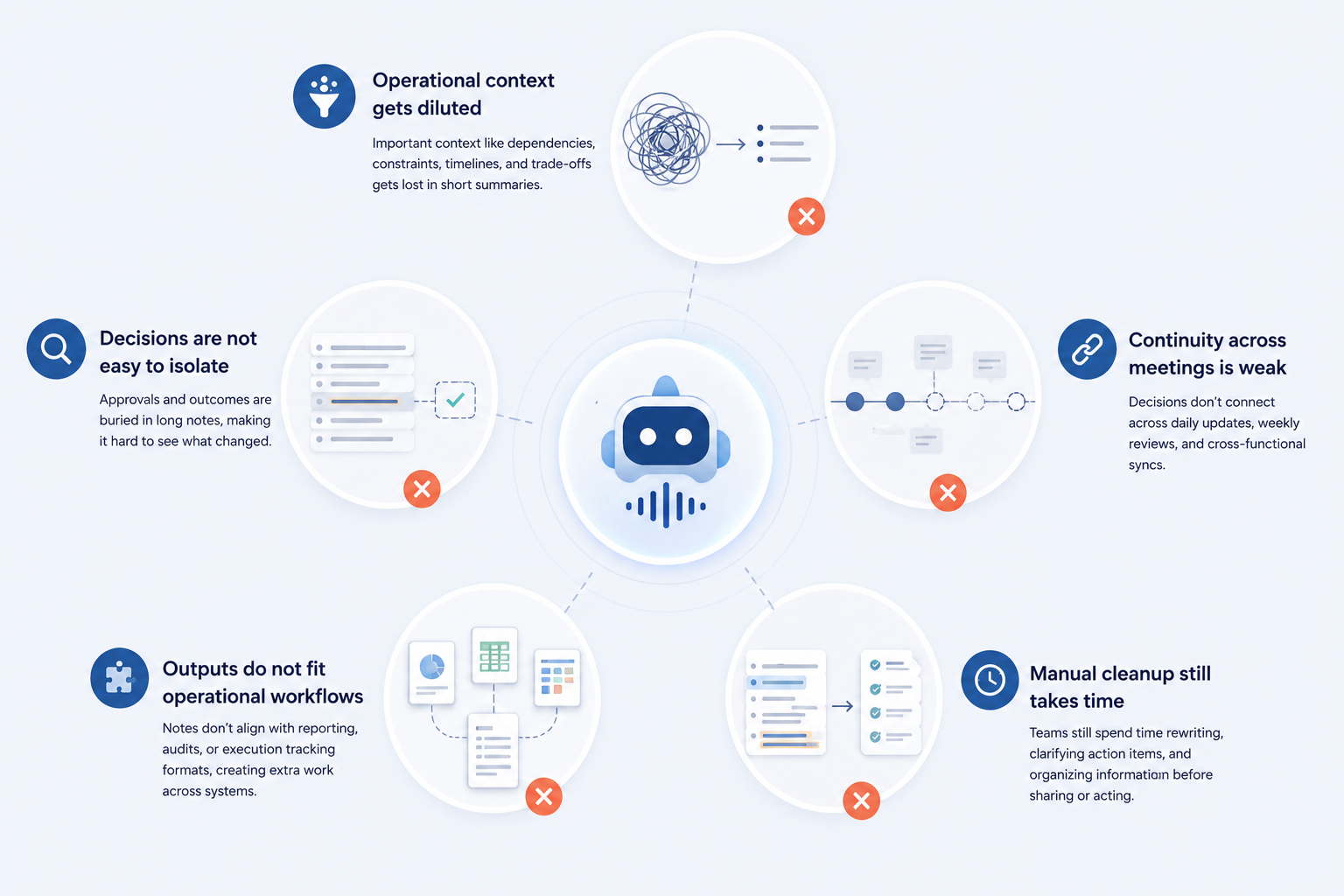
Most tools capture meetings well. The real friction shows up later, when operations teams try to use those notes to manage work, track decisions, or coordinate across teams.
Where things usually break down:
- Operational context gets diluted: Operations discussions involve dependencies, constraints, timelines, and trade-offs. When notes are reduced to short summaries, the reasoning behind decisions becomes difficult to follow later.
- Decisions are not easy to isolate: Approvals and outcomes often sit within longer blocks of text. Instead of getting a clear view of what changed, teams spend time scanning through notes.
- Continuity across meetings is weak: Operations work moves across daily updates, weekly reviews, and cross-functional syncs. When each meeting stands alone, teams lose track of how decisions evolved over time.
- Outputs do not fit operational workflows: Notes that work for quick reference do not always fit into reporting, audits, or execution tracking. Inconsistent structure makes them harder to use across systems.
- Manual cleanup still takes time: Even with AI tools, teams often rewrite notes, clarify action items, and organize information before sharing or acting on them.
These gaps do not disrupt the meeting itself. They surface later, when someone needs to act, report, or follow through on what was discussed.
How Aimey.ai Meeting Assistant Helps Operations Teams
Aimey.ai AI Meeting Assistant supports project operations teams by turning meeting discussions into clear outputs that teams can act on without delay. It helps keep projects aligned, tasks visible, and decisions easy to track across stakeholders.
Here’s how it fits into day-to-day project operations:
- Structured meeting notes: Captures updates from sprint reviews, status calls, and stakeholder meetings in a clean format, so teams can quickly review progress, blockers, and timelines.
- Decision clarity: Highlights scope changes, approvals, and priority shifts, making it easier to track what changed and how it impacts delivery.
- Action tracking: Pulls out tasks with clear ownership and next steps, helping teams stay on top of deliverables, dependencies, and follow-ups.
- Searchable records: Keeps a record of project discussions, which helps teams revisit decisions, resolve confusion, and stay aligned across multiple workstreams.
- Consistent documentation: Maintains a standard format across all project meetings, which improves visibility for managers and reduces gaps in communication across teams.
Aimey.ai runs in the background during meetings, so operations teams can focus on decisions while documentation stays structured and usable. Schedule a demo to see how Aimey.ai can streamline your operations meetings.
Get Started With Aimey.ai Meeting Assistant
Aimey.ai meeting assistant sits close to sensitive decisions, not just routine notes in operations. So the setup needs to be tight from the start. Here’s a clean way to roll it out without creating risk.
Step 1: Start with a contained rollout: Test in a controlled setting before wider use with a 14-day free trial. Use a small operations group and a couple of cross-functional partners. Run it in meetings like budget reviews and vendor calls so you see how it performs in real discussions.
Step 2: Define when recording should not happen: Set clear no-go conditions upfront.
- Exclude meetings with legal or senior leadership
- Use tags like “Confidential” or “No Record” in titles
- Restrict recording for specific rooms or meeting types
Step 3: Control access based on roles: Keep visibility aligned with responsibility.
- Limit transcripts to relevant stakeholders
- Restrict sensitive topics like headcount or deals
- Match permissions to your org structure
Step 4: Set expectations in the room: Make its role clear from the start.
Let participants know it’s there to capture decisions and actions. When positioned well, tools like Aimey.ai stay in the background and keep documentation consistent without disrupting the flow.
Step 5: Keep a human review step: Accuracy matters more than speed.
- Assign one owner to review summaries
- Validate numbers and commitments
- Share only after a quick check
Step 6: Treat outputs like records, not notes: Manage them with intent. Ensure transcripts follow your retention and deletion policies so nothing sits around unmanaged.
Step 7: Expand only when it’s stable: Scale based on control, not urgency. Start with lower-risk meetings, then move into more sensitive discussions once everything is working as expected.
FAQs
1. What should I expect from an AI meeting assistant for operations teams?
It should help you make sense of the meeting after it ends. You should be able to see what was decided, who owns what, and pick things up later without having to rely on memory.
2. Can an AI meeting tool support complex operations discussions?
Operations meetings tend to jump between approvals, timelines, and updates. It helps to have something that captures the key points so nothing important slips through once everyone moves on.
3. Is it safe to use an AI meeting assistant for sensitive operations discussions?
That really comes down to the tool. For operations work, you need proper access control and secure storage so the information stays with the right people.
4. How does an AI meeting assistant help with compliance and audits?
It gives you a record you can go back to. When someone asks what was approved or discussed, you have something concrete to refer to instead of piecing things together.
5. Do operations teams still need to review AI-generated meeting notes?
Yes, a quick pass always helps. It makes sure the details are right before the notes are shared or used for follow-ups.