A sales team uploads customer call recordings into an AI note-taker. An operations manager connects an AI assistant to the HR document library. A support lead turns on AI-drafted ticket replies wired into the CRM.
Each decision looks harmless on its own. Together, they put sensitive customer, employee, and financial data inside systems nobody reviewed as a whole. Then the questions arrive: who can see this data, how long is it kept, is it used to train models, and could anyone reconstruct what the AI did?
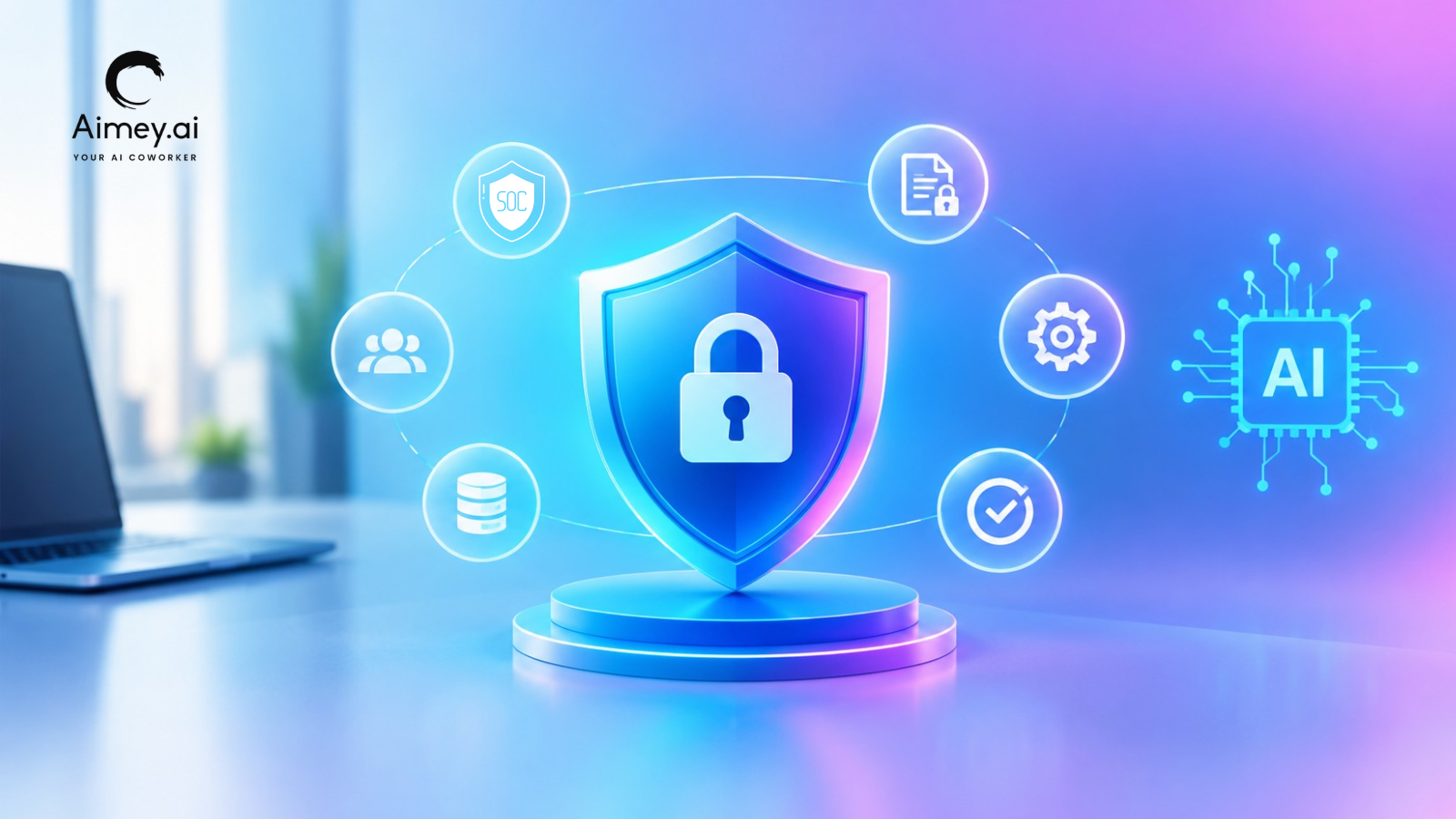
That’s why SOC 2 compliant AI has become a practical baseline rather than a procurement checkbox. It’s one of the clearest ways to tell whether an AI platform can be trusted inside real business operations.
Why AI Adoption Creates New Security and Compliance Questions
Traditional SaaS follows predictable paths: a user enters data, the application stores it, and a report reads it back. AI systems behave differently. They take in large amounts of unstructured content, generate new outputs, and increasingly take actions across several connected systems at once.
That flexibility is where the value comes from, and also where the risk grows. An AI that summarizes sales calls holds pricing discussions. An agent with CRM access can read contract records. A support assistant processes personal information in every ticket it touches.
Without proper controls, basic questions get hard to answer. Who can access the data? Are prompts and outputs logged, and for how long? Can access be revoked quickly? Does the vendor use customer data for training? What happens during an incident? AI compliance is increasingly about operational discipline, not paperwork.
What Does SOC 2 Mean for AI?
SOC 2 is an attestation framework from the American Institute of Certified Public Accountants (AICPA). An independent CPA firm examines a service organization’s controls against five Trust Services Criteria: security, availability, processing integrity, confidentiality, and privacy. Security is included in every SOC 2 report. The other four are included when the vendor puts them in scope.
Two points are often misunderstood. First, SOC 2 isn’t a certification. The output is an auditor’s report, and buyers need to read it. Second, a Type I report assesses whether controls were designed properly at a single point in time, while a Type II report tests whether they operated effectively over a period, usually three to twelve months. For AI platforms that touch production data, Type II is the stronger evidence.
For AI, SOC 2 focuses less on the model and more on the environment around it: identity and access management, encryption at rest and in transit, logging and monitoring, change management, vendor management, data retention, and incident response.
Why SOC 2 Compliant AI Matters for Businesses
An AI tool without a compliance program can look great in a demo. The problems show up later, in procurement reviews, customer audits, or the first-time security asks for evidence. SOC 2 compliant AI reduces that friction in three ways.
It Supports Vendor Review and Procurement
Security and procurement teams now routinely request a SOC 2 report, a subprocessor list, retention policies, and an explanation of how customer data is isolated. That scrutiny goes up when the AI connects to Salesforce, HubSpot, ServiceNow, Microsoft 365, HRIS, or an ERP. A vendor that can’t answer clearly tends to stall in review, however good the product is.
It Strengthens Customer Trust
Your own customers are asking how you use AI. If your support team summarizes customer conversations with an AI tool, enterprise clients will want to know whether the vendor has a current SOC 2 report, whether transcripts are kept or used for training, and who can see the output. A vendor with a Type II report lets you answer with evidence instead of assurances.
It Makes Scaling Safer
One team experimenting with AI is easy to manage by hand. Ten teams running AI workflows isn’t. At that scale you need consistent authentication, permissions, approvals, logging, and incident response, and a vendor with a mature SOC 2 program has usually built them already.
Practical Risks of Using Non-Compliant AI Tools
AI With Access to Customer Records
An AI assistant connected to the CRM can summarize account histories, open tickets, and suggest next steps. If it uses one broad service account rather than each user’s own permissions, anyone who can ask it a question can see records they were never meant to access. Weak logging then makes it hard to know what was exposed. Role-based access, permission-aware retrieval, and audit logs are the controls that matter here. Even then, decide who should see AI-generated customer insights at all.
AI Summarizing Calls and Support Conversations
Sales calls contain pricing, contract terms, and roadmap discussions. Support conversations may contain personal or regulated information. Without clear retention rules, transcripts are retained indefinitely and shared much more widely than anyone ever intended. Look for defined retention periods, encryption, and role-based access. Keep human review in place for escalations and regulated conversations.
AI Searching Internal Documents
AI search across contracts, financial reports, HR policies, and strategy documents is useful, but it surfaces whatever it can reach. The bigger risk is often internal overexposure rather than an outside breach: an employee asks a broad question and gets a sensitive answer. The AI has to respect the document permissions your organization already has, and your team still owns how documents are classified.
AI Agents Executing Backend Workflows
AI agents don’t just generate text. They create tickets, update CRM records, send emails, and move documents. An agent with overly broad permissions can disrupt operations quickly, and without logging nobody can reconstruct what happened. Scoped credentials, action-level audit trails, change management, and human approval for financial, legal, or customer-facing actions are what keep automation accountable.
Where Aimey.ai Fits
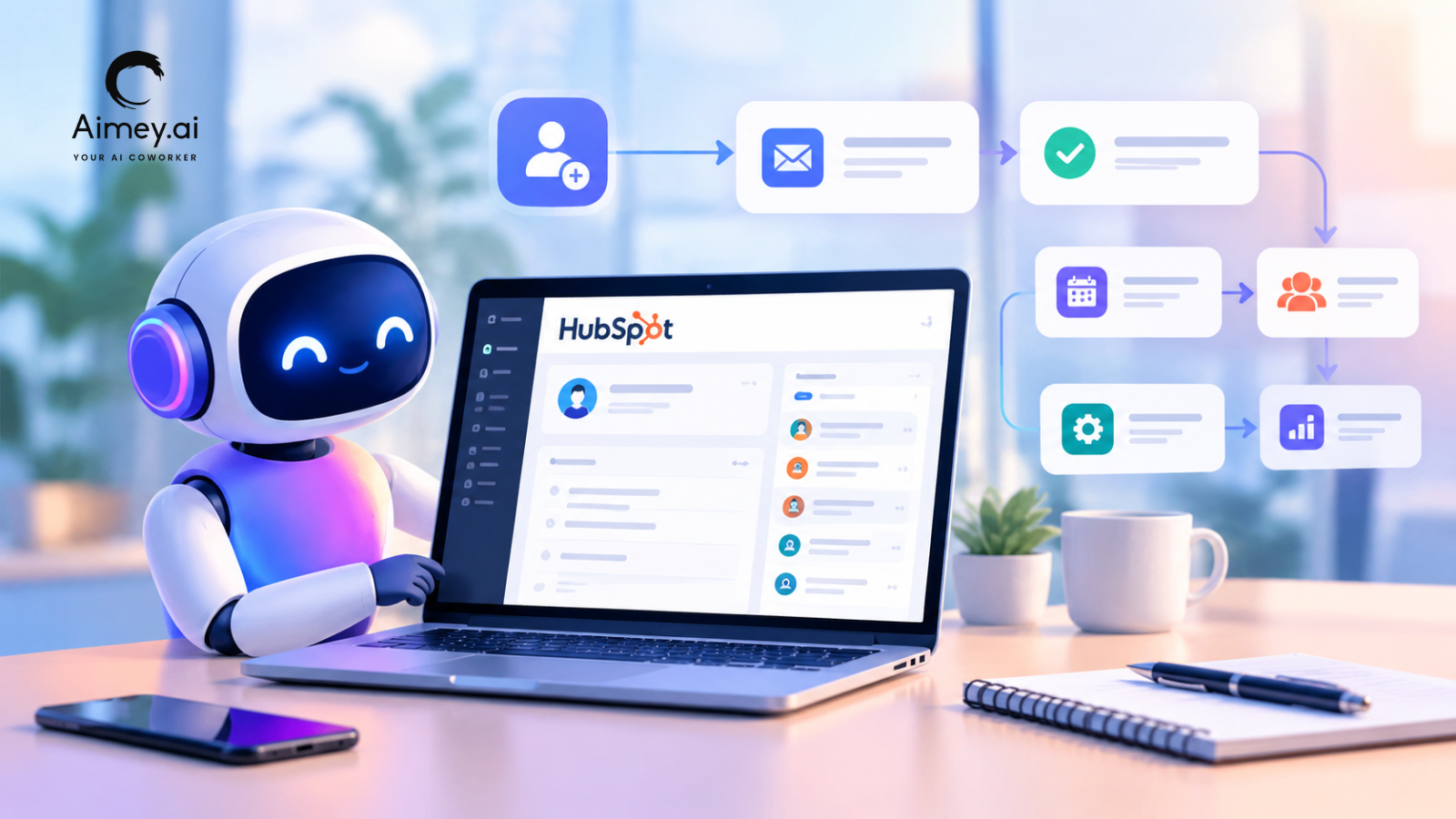
Aimey.ai is an agentic AI platform for workflow orchestration across the systems businesses already run: Microsoft 365, CRMs like HubSpot, Dynamics 365, and Salesforce, and project tools like Jira and Asana. That is exactly the kind of deployment where the risks above apply, because agents read from and act in several systems at once.
For that reason, governance is built into how Aimey.ai workflows are designed rather than added afterward. Integrations are scoped to the access a workflow needs. Human-in-the-loop approval steps sit before sensitive or customer-facing actions. Agent activity is logged so teams can see what was done and why.
Whichever platform you evaluate, ask the vendor to show you these controls working in the product, not just described in a policy document.
What Businesses Should Check Before Adopting an AI Platform
SOC 2 status matters, but it’s the start of the review, not the end. When you get the report, check three things first. Does its scope include the AI product you’re buying? Is the review period recent, and if not, is there a bridge letter? Are key subprocessors, such as the model provider, carved out? If they are, request their reports too.
Then work through the product-level questions:
| Area | What to ask |
| Data use | Is customer data used to train models, by the vendor or its model provider? Is that in the contract? |
| Retention | How long are prompts, files, transcripts, and outputs kept, and how are deletions handled? |
| Access | Does the AI respect each user’s permissions in source systems? Can admins restrict access by team? |
| Logging | Can you export logs of who used the AI, what it accessed, and what it did? |
| Oversight | Can workflows require human approval before actions run? |
| Integrations | How are API credentials scoped, stored, and rotated? |
| Incidents | What is the documented response process, and how fast are customers notified? |
The strongest programs pair these technical controls with clear internal policies on the customer side.
What SOC 2 Does and Does Not Guarantee
SOC 2 tells you a vendor’s security and operational controls were independently tested. It doesn’t tell you whether the AI’s outputs are accurate or unbiased, whether you comply with sector regulations like HIPAA or GDPR, or whether you’re immune to attack. Model behavior is covered by separate frameworks, such as ISO/IEC 42001 and the NIST AI Risk Management Framework.
SOC 2 also says nothing about your own side of the arrangement. Every report lists complementary user entity controls, the things the customer is expected to do. Beyond those, you still need your own AI governance: an acceptable-use policy, rules for which data can go into which tools, human oversight requirements, approval processes, and staff training. Compliance is one layer of that framework, not a replacement for it.
Common Mistakes When Evaluating AI Compliance
The most common mistake is evaluating the model and ignoring the environment around it: the integrations, the permissions, and the data flows. That environment is where most real incidents begin.
Another is assuming a consumer AI tool is fine for business data because everyone already uses it.
Consumer terms on data retention and training are often very different from enterprise terms.
Teams also underestimate agents. An assistant that only reads data carries different risks from one that can update records or send email, and the review should reflect that.
Finally, some buyers treat a SOC 2 report as proof of safety and stop there. No framework removes risk entirely. The better approach is layered: a vendor with tested controls, scoped access, auditability, human oversight, and regular internal review.
FAQ
What does SOC 2 mean for AI?
It means an independent auditor has examined controls around how an AI vendor manages security, confidentiality, access, monitoring, and data protection. It is about the vendor’s operating environment, not the quality of the model outputs.
Should businesses only use SOC 2 compliant AI?
Different use cases require different levels of scrutiny. But any AI deployment that touches customer data, employee data, or operational systems should come from a vendor with a current SOC 2 Type II report, or equivalent evidence such as ISO/IEC 27001 certification.
Does SOC 2 guarantee AI security?
No. It shows a vendor’s controls were designed and, for Type II, operated effectively over a review period. It doesn’t eliminate risk, guarantee accurate outputs, or cover the controls your own organization is responsible for.
How can companies deploy AI securely?
Combine vendor due diligence (including reading the SOC 2 report) with role-based permissions, audit logging, retention limits, human approval for sensitive actions, staff training, and regular governance reviews.
Conclusion
AI adoption has become an operational decision. Once AI systems can reach customer data, internal documents, and backend workflows, security and governance expectations rise to match.
SOC 2-compliant AI gives businesses a stronger foundation for meeting them. It accelerates procurement, gives customers proof instead of promises, and makes it safer to scale AI across teams. It isn’t a substitute for governance, though. You still need clear internal policies, human oversight, and ongoing review.
The organizations that succeed with AI long term won’t be the ones that deployed the fastest tools. They’ll be the ones that deployed systems they can explain, audit, and trust inside real business operations.