How AI Can Automate QuickBooks, Invoice Creation and Finance Workflows
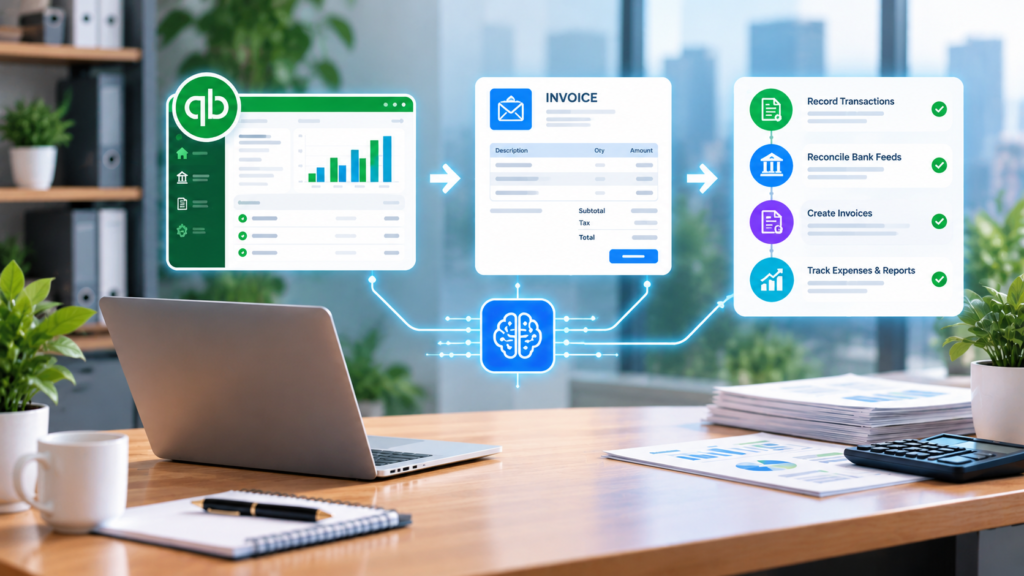
Finance teams rarely struggle because QuickBooks is missing features. They struggle because billing information lives in too many places at once. A project manager approves work in email. A salesperson updates the deal value in the CRM. Purchase orders arrive as PDFs. Hours sit in a spreadsheet. The billing terms are in a contract that accounting doesn’t see until month-end. The result is familiar: late invoices, duplicate data entry, inconsistent records, and finance staff chasing information instead of reviewing it. AI QuickBooks automation helps with exactly that. It doesn’t replace the accounting team. It gathers, extracts, routes, and syncs financial information across the systems you already use, so invoices go out faster, receivables move sooner, and approval controls stay intact. Why Finance Workflows Still Depend on Manual Work A single invoice can depend on a CRM record, a project milestone, an email approval, a contract, a timesheet, and a customer PO. QuickBooks only sees the end result. QuickBooks’ built-in automation handles structured work well: recurring invoices, bank rules for transaction categories, scheduled reminders, and bank feed matching. It struggles with unstructured instructions. Picture an email to accounts receivable that says, “Please invoice the remaining 50% after installation approval.” A person understands it immediately. A rule-based tool has nothing to trigger on. That’s the gap AI for accounting fills. It reads emails, documents, and approvals for operational context, then starts the right workflow. This matters because most finance delays happen before the data ever reaches the accounting system. What AI Adds to QuickBooks Automation AI is most useful as a workflow layer around QuickBooks, not a replacement for it. QuickBooks stays the financial system of record. AI moves information in and out of it more reliably. A platform like Aimey.ai can read incoming emails and attachments, extract billing details from contracts and POs, detect invoice triggers in CRM updates, run approval workflows, suggest payment matches, send reminders, and surface bottlenecks. Each of those steps either prepares work for a person or acts within limits a person has set. That’s the core principle here. AI accounting workflows remove repetitive handling, and financial judgment stays with the finance team. Practical Ways to Use AI with QuickBooks Can AI automate QuickBooks? In many areas, yes. The more useful question is which workflows benefit most. Creating Invoices From CRM Deals and Approved Work For many service organizations, invoicing is dependent on a sequence of steps. Sales closes the deal. Operations delivers. Approval arrives via email or slack. Finance creates the invoice by copying details from 3 systems. Or Aimey.ai may watch for the trigger instead. That may be a CRM deal stage changing to “Implementation Complete,” a project milestone being signed off, or a client acceptance email. It then takes in the billing details and approved pricing and prepares a draft invoice in QuickBooks for finance to verify before sending it out. Billing cycles are shorter, and fewer invoices are missed. Custom price, contested scope, tax treatment and odd terminology still require a person to check them. Extracting Billing Details From Contracts and POs Finance teams commonly examine contracts manually to identify the billing schedule, PO number, payment milestones, legal entity and net terms. AI can pull these facts out of contracts, statements of work, and POs and then check them before an invoice is generated. If a customer’s PO requires a reference number, department code or split invoicing, the process may identify what’s lacking up front, which means fewer rejected invoices. Accountants should still look at advanced contract language, multi-entity billing, and anything with revenue recognition implications. Keeping Customer and Vendor Records in Sync The billing address is updated in CRM but not in QuickBooks. Vendor updates tax details; no one tells finance. AI can watch email, forms, and CRM modifications and recommend corresponding changes across systems to keep CRM and accounting data aligned. It can also find duplicate vendors and missing tax IDs. Changes to vendor bank details should always be subject to specific approval. They’re a regular target for payment fraud. Categorizing Transactions Bank rules bring you to a consistent vendor but break when descriptions change. AI can recommend account mappings with a confidence score based on prior categorization, vendor history, and supporting documents. Routine stuff goes fast, while anything large, weird, capital-related or tax-sensitive goes to a bookkeeper. Using AI for Receivables and Finance Visibility Matching Payments to Invoices QuickBooks bank feed matching handles simple payments. It becomes more difficult if a customer pays part of an invoice, makes one transfer for three bills, leaves off the reference number or sends remittance details in another email. AI can examine quantities, client history, remittance emails and open bills to recommend the most likely matches, then send anything uncertain to an exception queue. Reconciliation is quicker, and staff time is spent on true differences, disputed balances and substantial changes. Automating Reminders and Overdue Follow-Ups Collections follow-up is important, and it’s usually the first thing dropped when finance gets busy. AI can run a consistent collections process based on invoice age, payment history, and contract terms, with escalation built in. For example: At 7 days past due, a friendly reminder goes out automatically. At 30 days, a review task is created for the finance team. At 60 days, leadership is notified, and someone decides on the next step. Because Aimey.ai can see the account’s history, reminders can reference the actual invoice and conversation instead of a generic template. Relationship decisions, like payment plans or disputes, stay with people. Finance Summaries and Bottleneck Detection Preparing reporting usually starts with pulling data from several systems. AI can bring together invoice activity, AR aging, payment trends, and approval delays into a regular summary for the controller. It can also follow the process across systems and show where it slows down: sales approvals that arrive late, POs missing references, project sign-offs that stall, and invoices that keep needing corrections. That’s visibility small finance teams rarely have time to build by hand. Final reporting and forecasting stay with
How to Use AI with HubSpot to Automate CRM Workflows

Most CRM problems aren’t caused by missing features. They come from inconsistent execution. A rep finishes a call and doesn’t move the deal stage. A lead lands with the wrong owner because the routing rules were written two reorganizations ago. The customer’s real objections live in a meeting recording nobody will rewatch. Duplicate contacts pile up, and by the end of the quarter, nobody fully trusts the pipeline report. HubSpot workflows solve part of this, but they depend on someone keeping the inputs clean. Using AI with HubSpot addresses the other part: it reads conversations, summarizes interactions, fills in records, and triggers the next step based on what actually happened. The point isn’t to take people out of the process. It’s to take the CRM maintenance off their plate. Why Traditional CRM Workflows Still Require Manual Work HubSpot workflows are rule-based. If a form is submitted, assign the lead. If a deal enters a stage, send an email. If a property changes, notify the owner. Those rules are reliable, but only when the data that feeds them is entered correctly and on time. In practice, much of that data starts out unstructured. It sits in a call, an email reply, or a calendar invite. Turning it into a property value is still someone’s job: writing the meeting summary, updating the contact, logging the follow-up, deciding which leads deserve attention today. There’s a second problem too. As teams add more workflows to cover more cases, the workflows themselves get harder to maintain. Rules overlap, conditions drift out of date, and nobody is sure which one fired. More rules alone don’t fix this. What AI Adds to HubSpot Automation AI fills the gap between what happens in a sales conversation and what HubSpot workflows can act on. In practice, it works in three stages. First, it reads unstructured inputs: transcripts, emails, notes, and activity history. Next, it turns them into structured outputs such as a summary, a property value, a priority flag, or a suggested task. Finally, it writes those outputs back to HubSpot, where your existing workflows take over. HubSpot AI covers a growing share of this inside the CRM. Many teams also connect an external platform when the work spans other systems. Aimey.ai, for example, connects HubSpot with Microsoft 365, meeting platforms, and project tools, so one event can update the deal, create a task, and draft an email in Outlook. The principle stays the same either way: AI does the interpreting, HubSpot does the executing, and people keep the judgment calls. Practical Ways to Use AI with HubSpot Automatically Summarizing Customer Interactions Today, a rep runs the call, scribbles partial notes, and promises to update HubSpot later. Objections get lost, and the deal record says little more than “demo done.” Aimey.ai can turn the transcript into structured meeting summaries covering decisions, concerns, action items, and owners, then log them to the matching contact, company, and deal records. Managers get pipeline context without asking for it, and reps get back the time they would have spent writing notes. Pricing discussions and sensitive conversations are worth a quick human check before anything is logged. Updating CRM Records Records go stale because reps reasonably put customers ahead of data entry. AI can pick up the details that matter from emails and meetings, such as a new decision-maker, a confirmed next meeting, or a product area of interest, and propose updates to HubSpot properties. You decide how much is automatic. Low-risk fields can be written directly. Deal amount, close date, and stage changes can wait in a review queue for the owner. RevOps gets cleaner reporting without depending entirely on rep discipline. Lead Qualification and Behavior-Based Triggers Static lead scoring counts actions: an opened email, a visit to the pricing page, a form fill. It can’t read intent. A reply asking about rollout timelines and security reviews says far more than three page views. AI can assess the content of inbound messages and early conversations, then write a priority signal or a short intent summary to a HubSpot property. Workflows can trigger on that property the same way they trigger on any other. SDRs work the strongest leads first. Keep reviewing the outputs, because AI can misread tone, especially in long B2B cycles. Lead Routing Routing rules break as companies grow: overlapping territories, industry specialists, named enterprise accounts, existing customers submitting new forms. AI can weigh account ownership, past engagement, industry, and company size together, then pass a suggested owner into a HubSpot workflow. An existing customer asking about expansion can skip SDR qualification and go straight to their account manager. Log the reason for each assignment so RevOps can fix bad patterns. Contact and Company Data Enrichment Incomplete records hurt segmentation, scoring and area planning. AI is able to bridge gaps in the data it can observe, like titles in email signatures, responsibilities discussed in meetings, and company info from linked sources. It can also indicate potential duplicates. AI, to be fair, can’t generate credible firmographics, like headcount, without a data source behind it; therefore, link it with an enrichment provider for those categories. Keeping merges and modifications to high-value accounts manual is another part of protecting CRM data quality. Examples of AI-Powered CRM Workflows The use cases above become most valuable when they’re chained into workflows. The same pattern applies to AI-powered backend workflows beyond sales, but these are the ones most HubSpot teams start with. Follow-Ups and Task Creation After a Demo Reps often go straight from one call into the next, and the recap email slips to tomorrow. Aimey.ai can draft the recap from the meeting transcript, including the specific questions raised, and create the follow-up tasks in HubSpot with owners and due dates. HubSpot workflows then handle reminders and flag the deal if the customer goes quiet. The rep reviews the email before it goes out, because outbound messages carry the relationship. Personalized Outreach Generic sequences are easy to ignore. AI can draft re-engagement, renewal, or account-based